
Kenya is one of many African countries on the frontlines of climate change. As the second largest country in East Africa, it has a diverse topography characterised by coastal lowlands, savannah grasslands, highlands, and the Great Rift Valley, sharing borders with Uganda to the West, Tanzania to the South, and the Indian Ocean to the East.
Kenya’s climate ranges from tropical along the coast to arid and semi-arid in the North and temperate in the highlands. The country’s overall climate is characterised by bimodal rainfall patterns, with long rains from March to May and short rains from October to December. Extreme heatwaves, unpredictable rainfall patterns, and sea level rise are greatly impacting the country. Particularly, key sectors of Kenya’s economy such as agriculture, tourism, health, and energy have been significantly affected, leading to food and water insecurity, disrupted livelihoods, and destruction of infrastructure.
These challenges heavily affect young people between 15 and 35 years, which account for 35% of Kenya’s total population, and those aged below 15 years, which constitute 43%. These groups are among the most vulnerable and are highly susceptible to climate change and its impacts.
A significant portion of urban dwellers in developing countries, especially in Africa, reside in informal settlements. Informal settlements are areas where people live in often poorly constructed housing and lack access to basic services and utilities such as clean water, electricity, and sanitation to varying degrees, depending on the size, setup, and infrastructure of the settlement (e.g., poor roads and drainage systems). These areas tend to host diverse groups of people including youth, the elderly, migrants, Internally Displaced Persons (IDPs), international refugees, Persons with Disabilities (PWDs), and women.
These urban dwellers, especially youth, are attracted to urban areas due to the–perceived or actual–opportunities for social and economic empowerment, however most of them end up residing in informal settlements due to the unavailability of affordable housing and their expectations not being met. Although many informal dwellers do not intend to reside in these areas permanently, most of them end up residing there beyond their intended duration of stay. Over time, these informal settlements grow to the point that they end up forming part of their respective cities.
Approximately 60% of Kenyans living in urban areas reside in some form of informal settlement, with some of the biggest informal settlements found in major cities like Nairobi, Kisumu and Mombasa. These settlements include Kibera, which is Africa’s largest informal settlement with a population of 250,000; Mathare in Nairobi; Manyatta in Kisumu; and Kisumu Ndogo in Kilifi.
Due to the factors outlined above, youth residing in informal settlements are particularly vulnerable to shocks and often bear the brunt of climate change impacts. These impacts and other associated challenges disrupt their wellbeing not only in the short term but also in the long term, including through the following:
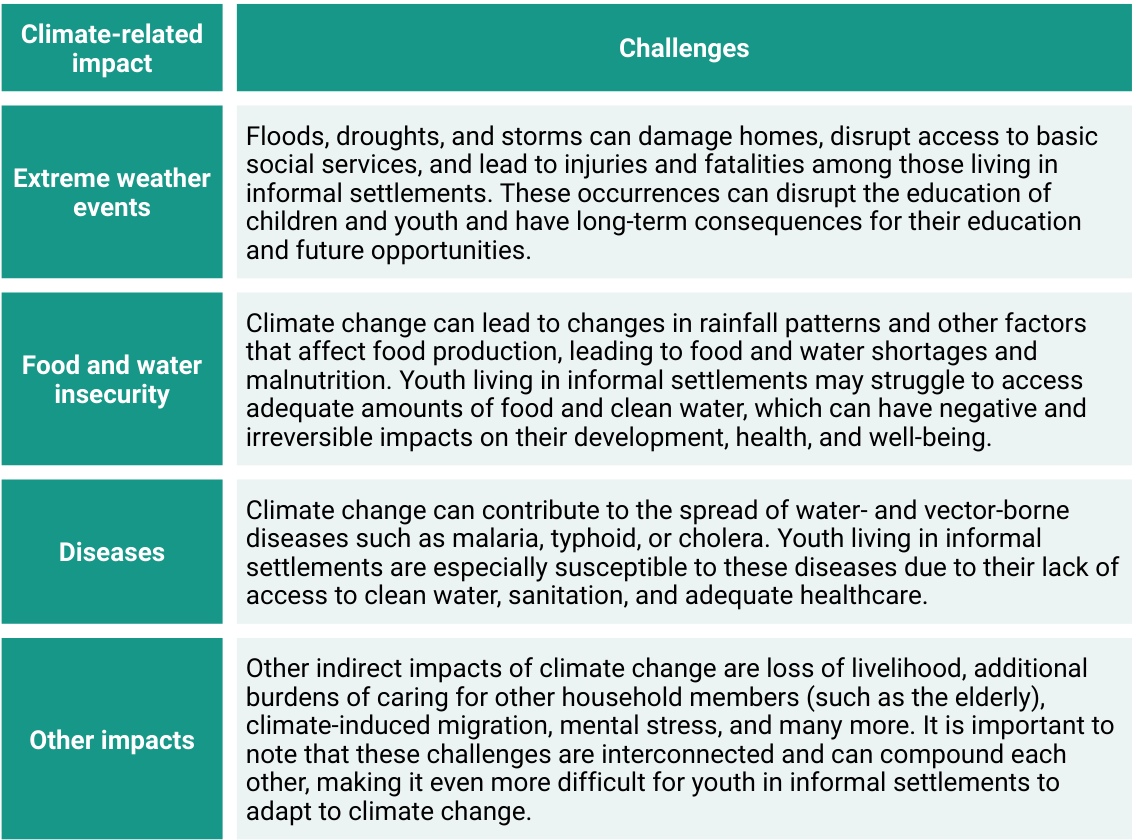
It is important to note that these challenges are interconnected and can compound each other making it even more difficult for youth in informal settlements to adapt.
Youth awareness on climate change and engagement in climate action plays a pivotal role in building resilience. Various studies conducted in areas such as Kibera, Mathare, Korogocho, and Mukuru show that young people in these communities have a broad understanding of climate change and its impacts on themselves and their neighborhoods. Many of them identified a correlation between environmental shifts such as longer dry spells and frequent floods, and the broader climate change trends.
While young people in informal settlements may have limited capacity regarding climate change, there are several youth-affiliated groups that have taken initiative to tackle climate change and its impacts in their respective communities. These initiatives are promoting environmental education and resilience among youth through engagement in activities such as urban farming and clean-ups under the KombGreen Solutions initiative, community sensitization and building climate literacy under the Future Yetu initiative and mobilizing the young people to plant trees in the pockets of green spaces in their respective communities under the Ayiera initiative.
These initiatives sit against the backdrop of limited access to information and resilience building, which hinders their ability to create community-oriented solutions and become empowered to tackle climate issues. This leaves many young people relying on fragmented, experience-based knowledge rather than consistent, science-based understanding.
As highlighted above, youth living in informal settlements face a multitude of climate-related challenges. Despite this, they often manage to find new and innovative solutions to these challenges. The table below outlines some of the key needs as well as opportunities and existing solutions identified from a survey conducted by Amazon Theatrix in collaboration with SLYCAN Trust among youth living in the informal settlements of Nyalenda, Obunga, and Manyatta in Kisumu:
.png)
Based on the survey conducted by Amazon Theatrix in collaboration with SLYCAN Trust, the following are recommendations for various stakeholders to address the needs of youth in informal settlements as well as to increase their awareness of climate change.
Climate-related impacts are significantly affecting the already precarious living conditions of informal dwellers. This article highlights the increased vulnerabilities of young people living in informal settlements in Kenya to climate hazards and shows that their living conditions intensify their exposure to climate risk, thereby impeding their ability to adapt. This has led to disruptions of livelihoods, further aggravating socio-economic exclusion, and amplifying the existing inequalities. The Government of Kenya, by being a party to the UNFCCC processes and developing its National Adaptation Plans (NAPs) and Nationally Determined Contributions (NDCs), has made concentrated efforts to raise awareness, mitigate, and adapt to the impact of climate-induced events. However, there is still a need to further raise climate change awareness of informal dwellers in Kenya and enhance opportunities to enhance their capacity for climate action and become more climate-resilient.
Despite the above challenges, there are opportunities for targeted interventions that will enhance climate resilience among informal dwellers. A multifaceted approach among local governments, development practitioners, and community organizations is essential in developing a sustainable adaptation solution. Roundtable discussions on climate action that involve all stakeholders, particularly grassroots organizations and youth in informal settlements, are key to identifying sustainable solutions as well as empowering these actors to build resilience. Achieving this will require a holistic approach where indigenous and science-based practices are integrated into adaptation strategies to reduce vulnerabilities, as well as enhanced access to funding and other means of implementation for actors at the ground level.
Patricia is a Junior Research Associate at SLYCAN Trust. She holds a Bachelor of Laws (LL.B) degree from Strathmore University. She has experience in legal research, drafting, and policy analysis, and has worked with institutions including AF Mpanga Advocates and CM Advocates LLP. Through her work, Patricia has contributed to research and initiatives focused on climate change, sustainability, and development. She is particularly interested in climate advocacy, human rights, and advancing gender equality.
Esther Mireku works as a Programme and Research Associate for SLYCAN Trust while holding the position Assistant Program Officer working with the Environmental Protection Agency of Ghana, an environmentalist and a young climate change negotiator. A strong believer in environmental sustainability and proud to contribute toward its achievement, she has personally found benefit in regularly engaging in environmental education, including climate change advocacy, environmental compliance monitoring and enforcement, and environmental impact assessment administration. Esther holds Master in Energy and Sustainable Management from Kwame Nkrumah University of Science and Technology along with a Bachelor of Art in Integrated Development Studies with a specialization in Environment and Natural Resource Management from the University of Development Studies.

.png)
Kenya is one of many African countries on the frontlines of climate change. As the second largest country in East Africa, it has a diverse topography characterised by coastal lowlands, savannah grasslands, highlands, and the Great Rift Valley, sharing borders with Uganda to the West, Tanzania to the South, and the Indian Ocean to the East.
Kenya’s climate ranges from tropical along the coast to arid and semi-arid in the North and temperate in the highlands. The country’s overall climate is characterised by bimodal rainfall patterns, with long rains from March to May and short rains from October to December. Extreme heatwaves, unpredictable rainfall patterns, and sea level rise are greatly impacting the country. Particularly, key sectors of Kenya’s economy such as agriculture, tourism, health, and energy have been significantly affected, leading to food and water insecurity, disrupted livelihoods, and destruction of infrastructure.
These challenges heavily affect young people between 15 and 35 years, which account for 35% of Kenya’s total population, and those aged below 15 years, which constitute 43%. These groups are among the most vulnerable and are highly susceptible to climate change and its impacts.
A significant portion of urban dwellers in developing countries, especially in Africa, reside in informal settlements. Informal settlements are areas where people live in often poorly constructed housing and lack access to basic services and utilities such as clean water, electricity, and sanitation to varying degrees, depending on the size, setup, and infrastructure of the settlement (e.g., poor roads and drainage systems). These areas tend to host diverse groups of people including youth, the elderly, migrants, Internally Displaced Persons (IDPs), international refugees, Persons with Disabilities (PWDs), and women.
These urban dwellers, especially youth, are attracted to urban areas due to the–perceived or actual–opportunities for social and economic empowerment, however most of them end up residing in informal settlements due to the unavailability of affordable housing and their expectations not being met. Although many informal dwellers do not intend to reside in these areas permanently, most of them end up residing there beyond their intended duration of stay. Over time, these informal settlements grow to the point that they end up forming part of their respective cities.
Approximately 60% of Kenyans living in urban areas reside in some form of informal settlement, with some of the biggest informal settlements found in major cities like Nairobi, Kisumu and Mombasa. These settlements include Kibera, which is Africa’s largest informal settlement with a population of 250,000; Mathare in Nairobi; Manyatta in Kisumu; and Kisumu Ndogo in Kilifi.
Due to the factors outlined above, youth residing in informal settlements are particularly vulnerable to shocks and often bear the brunt of climate change impacts. These impacts and other associated challenges disrupt their wellbeing not only in the short term but also in the long term, including through the following:
It is important to note that these challenges are interconnected and can compound each other making it even more difficult for youth in informal settlements to adapt.
Youth awareness on climate change and engagement in climate action plays a pivotal role in building resilience. Various studies conducted in areas such as Kibera, Mathare, Korogocho, and Mukuru show that young people in these communities have a broad understanding of climate change and its impacts on themselves and their neighborhoods. Many of them identified a correlation between environmental shifts such as longer dry spells and frequent floods, and the broader climate change trends.
While young people in informal settlements may have limited capacity regarding climate change, there are several youth-affiliated groups that have taken initiative to tackle climate change and its impacts in their respective communities. These initiatives are promoting environmental education and resilience among youth through engagement in activities such as urban farming and clean-ups under the KombGreen Solutions initiative, community sensitization and building climate literacy under the Future Yetu initiative and mobilizing the young people to plant trees in the pockets of green spaces in their respective communities under the Ayiera initiative.
These initiatives sit against the backdrop of limited access to information and resilience building, which hinders their ability to create community-oriented solutions and become empowered to tackle climate issues. This leaves many young people relying on fragmented, experience-based knowledge rather than consistent, science-based understanding.
As highlighted above, youth living in informal settlements face a multitude of climate-related challenges. Despite this, they often manage to find new and innovative solutions to these challenges. The table below outlines some of the key needs as well as opportunities and existing solutions identified from a survey conducted by Amazon Theatrix in collaboration with SLYCAN Trust among youth living in the informal settlements of Nyalenda, Obunga, and Manyatta in Kisumu:
Based on the survey conducted by Amazon Theatrix in collaboration with SLYCAN Trust, the following are recommendations for various stakeholders to address the needs of youth in informal settlements as well as to increase their awareness of climate change.
Climate-related impacts are significantly affecting the already precarious living conditions of informal dwellers. This article highlights the increased vulnerabilities of young people living in informal settlements in Kenya to climate hazards and shows that their living conditions intensify their exposure to climate risk, thereby impeding their ability to adapt. This has led to disruptions of livelihoods, further aggravating socio-economic exclusion, and amplifying the existing inequalities. The Government of Kenya, by being a party to the UNFCCC processes and developing its National Adaptation Plans (NAPs) and Nationally Determined Contributions (NDCs), has made concentrated efforts to raise awareness, mitigate, and adapt to the impact of climate-induced events. However, there is still a need to further raise climate change awareness of informal dwellers in Kenya and enhance opportunities to enhance their capacity for climate action and become more climate-resilient.
Despite the above challenges, there are opportunities for targeted interventions that will enhance climate resilience among informal dwellers. A multifaceted approach among local governments, development practitioners, and community organizations is essential in developing a sustainable adaptation solution. Roundtable discussions on climate action that involve all stakeholders, particularly grassroots organizations and youth in informal settlements, are key to identifying sustainable solutions as well as empowering these actors to build resilience. Achieving this will require a holistic approach where indigenous and science-based practices are integrated into adaptation strategies to reduce vulnerabilities, as well as enhanced access to funding and other means of implementation for actors at the ground level.
