
Ocean governance has long been marginal in multilateral climate frameworks and has long represented one of the more consequential blind spots of international environmental diplomacy. Despite the ocean's critical role as a carbon sink, a thermal regulator, and the ecological foundation for coastal economies worldwide, it remains largely peripheral to the architecture of the Paris Agreement's implementation. The 2025 Ocean and Climate Change Dialogue mandated by COP26 Glasgow Climate Pact,1 convened during the June Climate Meetings 2025 (SB62), marked an attempt to address this imbalance ahead of COP 30 in Belém, Brazil.
This commentary synthesises the dialogue's principal findings across its three thematic pillars and draws out the structural and institutional implications for policymakers, negotiators, and the broader climate finance community.
The 2025 Nationally Determined Contribution (NDC) revision cycle represents what the dialogue's co-facilitators described as a "pivotal and time-bound" opportunity for states to embed ocean-based mitigation and adaptation measures into their communicated climate commitments. The evidence presented across expert panels and breakout sessions suggests this opportunity remains largely unrealised. While adaptation measures have gained incremental traction in recent NDC iterations, high-impact mitigation sectors, including offshore renewable energy and maritime transport decarbonisation remain systemically underrepresented.
The dialogue identified a range of ocean-based interventions that could be integrated into NDCs such as integrated coastal zone management, ecosystem-based adaptation, blue carbon ecosystem conservation and restoration, marine spatial planning, marine protected areas, climate-resilient fisheries management, and the decarbonisation of shipping. Several Parties offered instructive precedents, including Brazil's integration of blue carbon strategies through ProManguezal and ProCoral, Japan's quantified offshore wind commitments, and Fiji's comprehensive blue economy transition framework, each demonstrating that ambitious ocean integration is not aspirational but technically and institutionally achievable.
Critically, the dialogue resisted a reductive, standardised approach. Recognising the diversity of coastal geographies, governance capacities, and development trajectories, the notion from the floor throughout the dialogue emphasised that ocean-based measures must be calibrated to national circumstances and grounded in the free, prior, and informed consent of Indigenous Peoples and coastal communities. This is not only a procedural safeguard; there is growing evidence that locally co-designed ocean interventions substantially outperform top-down approaches in both implementation fidelity and long-term resilience outcomes.
The dialogue's second thematic focus addressed the structural underrepresentation of ocean systems within the Global Goal on Adaptation (GGA) indicators, an issue with direct implications for how adaptation finance is allocated, tracked, and evaluated at the multilateral level. Intervention from Parties and observers raised substantive concerns that current indicator development processes risk confining ocean considerations to a narrow subset of thematic targets, when the ocean's relevance extends across water, food security, health, infrastructure, ecosystems, and livelihoods. The consensus was that ocean dimensions must be mainstreamed across all GGA thematic targets rather than siloed within ecosystem-specific categories.
The design of robust, operationally viable ocean indicators presents genuine methodological challenges. Effective indicators must simultaneously satisfy global comparability requirements while retaining sufficient contextual sensitivity to be meaningful at the sub-national level. The discourse advocated for ecosystem-disaggregated metrics, capturing mangroves, coral reefs, seagrass beds, and deep-sea systems as distinct categories, alongside quantitative measures for ecosystem-based adaptation and nature-based solutions. Alignment with the Convention on Biological Diversity's Kunming-Montreal Global Biodiversity Framework indicators was repeatedly cited as both a pragmatic mechanism for reducing reporting duplication and a principled commitment to institutional coherence.
Persistent data deficits, particularly among small economies including Small Island Developing States (SIDS) and Least Developed Countries (LDC), represent the most structurally intractable barrier to meaningful ocean indicator development. Addressing this will require sustained investment in regional ocean observation infrastructure, capacity-building for developing-country researchers, and the systematic integration of Indigenous and local knowledge systems, which, as the majority agreed, frequently compensate for gaps in formal scientific data in precisely those regions most vulnerable to ocean-climate impacts.
The third thematic focus addressed the governance fragmentation that continues to impede coherent ocean-climate-biodiversity action, a structural challenge that spans across institutional mandates, inter-ministerial coordination, reporting architectures, and financing streams.
The 2025 UN Ocean Conference provided a timely backdrop, with its political declaration reaffirming the ocean-climate-biodiversity nexus and calling for accelerated implementation across relevant international instruments. The conference outcomes were welcomed as a significant diplomatic resource, but with the caveat that declaratory commitments must be translated into actionable national strategies, aligned NDC and National Biodiversity Strategy and Action Plan cycles, and concrete inter-ministerial coordination mechanisms.
The entry into force and early implementation of the BBNJ Agreement, the treaty governing marine biodiversity in areas beyond national jurisdiction was identified as a structural opportunity to advance integrated ocean governance at the global scale. With 50 ratifications already secured, the Agreement's provisions on climate-resilient marine protected areas, area-based management tools, and financial mechanisms for developing countries represent a meaningful complement to the Paris Agreement's adaptation architecture.
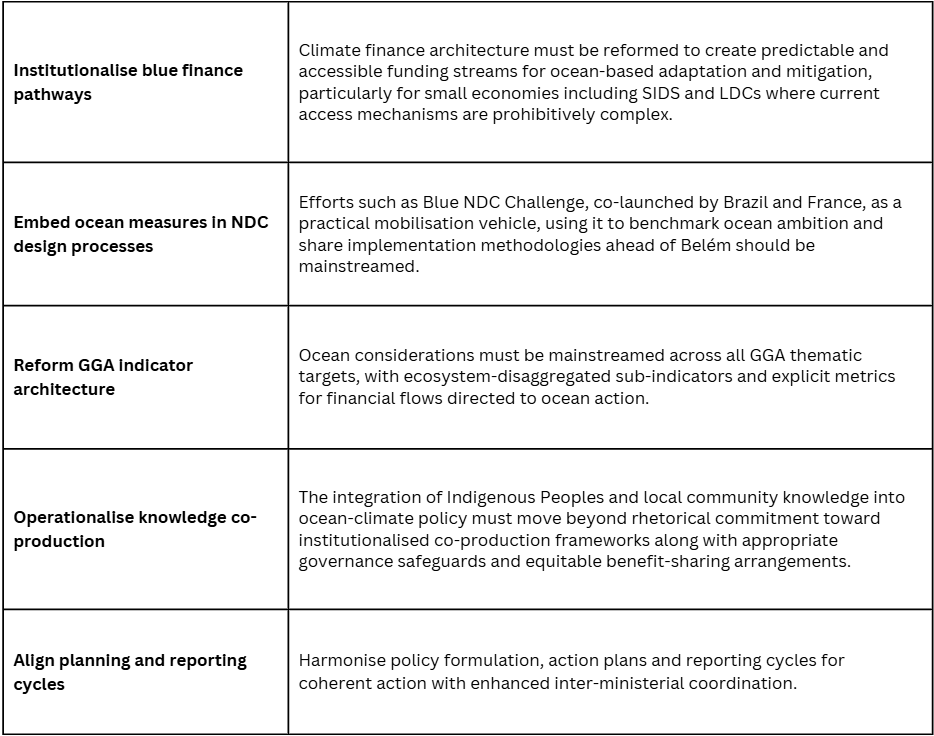
As the international community approaches COP30, the 2025 Ocean Dialogue clarified what coherent, ambitious ocean-climate governance requires. Institutional integration rather than duplication, financing architectures calibrated to ecological complexity, and a genuine commitment to the cognitive contributions of communities whose futures depend most directly on ocean health. The question is no longer whether the ocean belongs at the centre of climate diplomacy, it does. The question is whether political will and institutional architecture can be marshalled rapidly enough to match the pace of ocean change.
This commentary draws on the Informal Summary Report prepared by the co-facilitators of the Ocean and Climate Change Dialogue 2025, UNFCCC, published 30 September 2025.
Shifaz Ameer is a finance and administration professional who serves as a Programme and Communications Coordinator for SLYCAN Trust. Shifaz possesses a CIMA part-qualification and is currently pursuing an MBA at the University of Sunderland. Before taking on this role, Shifaz held a managerial position at a Cambridge English Assessments accredited exam preparation centre for over 5 years.

Ocean governance has long been marginal in multilateral climate frameworks and has long represented one of the more consequential blind spots of international environmental diplomacy. Despite the ocean's critical role as a carbon sink, a thermal regulator, and the ecological foundation for coastal economies worldwide, it remains largely peripheral to the architecture of the Paris Agreement's implementation. The 2025 Ocean and Climate Change Dialogue mandated by COP26 Glasgow Climate Pact,1 convened during the June Climate Meetings 2025 (SB62), marked an attempt to address this imbalance ahead of COP 30 in Belém, Brazil.
This commentary synthesises the dialogue's principal findings across its three thematic pillars and draws out the structural and institutional implications for policymakers, negotiators, and the broader climate finance community.
The 2025 Nationally Determined Contribution (NDC) revision cycle represents what the dialogue's co-facilitators described as a "pivotal and time-bound" opportunity for states to embed ocean-based mitigation and adaptation measures into their communicated climate commitments. The evidence presented across expert panels and breakout sessions suggests this opportunity remains largely unrealised. While adaptation measures have gained incremental traction in recent NDC iterations, high-impact mitigation sectors, including offshore renewable energy and maritime transport decarbonisation remain systemically underrepresented.
The dialogue identified a range of ocean-based interventions that could be integrated into NDCs such as integrated coastal zone management, ecosystem-based adaptation, blue carbon ecosystem conservation and restoration, marine spatial planning, marine protected areas, climate-resilient fisheries management, and the decarbonisation of shipping. Several Parties offered instructive precedents, including Brazil's integration of blue carbon strategies through ProManguezal and ProCoral, Japan's quantified offshore wind commitments, and Fiji's comprehensive blue economy transition framework, each demonstrating that ambitious ocean integration is not aspirational but technically and institutionally achievable.
Critically, the dialogue resisted a reductive, standardised approach. Recognising the diversity of coastal geographies, governance capacities, and development trajectories, the notion from the floor throughout the dialogue emphasised that ocean-based measures must be calibrated to national circumstances and grounded in the free, prior, and informed consent of Indigenous Peoples and coastal communities. This is not only a procedural safeguard; there is growing evidence that locally co-designed ocean interventions substantially outperform top-down approaches in both implementation fidelity and long-term resilience outcomes.
The dialogue's second thematic focus addressed the structural underrepresentation of ocean systems within the Global Goal on Adaptation (GGA) indicators, an issue with direct implications for how adaptation finance is allocated, tracked, and evaluated at the multilateral level. Intervention from Parties and observers raised substantive concerns that current indicator development processes risk confining ocean considerations to a narrow subset of thematic targets, when the ocean's relevance extends across water, food security, health, infrastructure, ecosystems, and livelihoods. The consensus was that ocean dimensions must be mainstreamed across all GGA thematic targets rather than siloed within ecosystem-specific categories.
The design of robust, operationally viable ocean indicators presents genuine methodological challenges. Effective indicators must simultaneously satisfy global comparability requirements while retaining sufficient contextual sensitivity to be meaningful at the sub-national level. The discourse advocated for ecosystem-disaggregated metrics, capturing mangroves, coral reefs, seagrass beds, and deep-sea systems as distinct categories, alongside quantitative measures for ecosystem-based adaptation and nature-based solutions. Alignment with the Convention on Biological Diversity's Kunming-Montreal Global Biodiversity Framework indicators was repeatedly cited as both a pragmatic mechanism for reducing reporting duplication and a principled commitment to institutional coherence.
Persistent data deficits, particularly among small economies including Small Island Developing States (SIDS) and Least Developed Countries (LDC), represent the most structurally intractable barrier to meaningful ocean indicator development. Addressing this will require sustained investment in regional ocean observation infrastructure, capacity-building for developing-country researchers, and the systematic integration of Indigenous and local knowledge systems, which, as the majority agreed, frequently compensate for gaps in formal scientific data in precisely those regions most vulnerable to ocean-climate impacts.
The third thematic focus addressed the governance fragmentation that continues to impede coherent ocean-climate-biodiversity action, a structural challenge that spans across institutional mandates, inter-ministerial coordination, reporting architectures, and financing streams.
The 2025 UN Ocean Conference provided a timely backdrop, with its political declaration reaffirming the ocean-climate-biodiversity nexus and calling for accelerated implementation across relevant international instruments. The conference outcomes were welcomed as a significant diplomatic resource, but with the caveat that declaratory commitments must be translated into actionable national strategies, aligned NDC and National Biodiversity Strategy and Action Plan cycles, and concrete inter-ministerial coordination mechanisms.
The entry into force and early implementation of the BBNJ Agreement, the treaty governing marine biodiversity in areas beyond national jurisdiction was identified as a structural opportunity to advance integrated ocean governance at the global scale. With 50 ratifications already secured, the Agreement's provisions on climate-resilient marine protected areas, area-based management tools, and financial mechanisms for developing countries represent a meaningful complement to the Paris Agreement's adaptation architecture.
As the international community approaches COP30, the 2025 Ocean Dialogue clarified what coherent, ambitious ocean-climate governance requires. Institutional integration rather than duplication, financing architectures calibrated to ecological complexity, and a genuine commitment to the cognitive contributions of communities whose futures depend most directly on ocean health. The question is no longer whether the ocean belongs at the centre of climate diplomacy, it does. The question is whether political will and institutional architecture can be marshalled rapidly enough to match the pace of ocean change.
This commentary draws on the Informal Summary Report prepared by the co-facilitators of the Ocean and Climate Change Dialogue 2025, UNFCCC, published 30 September 2025.
