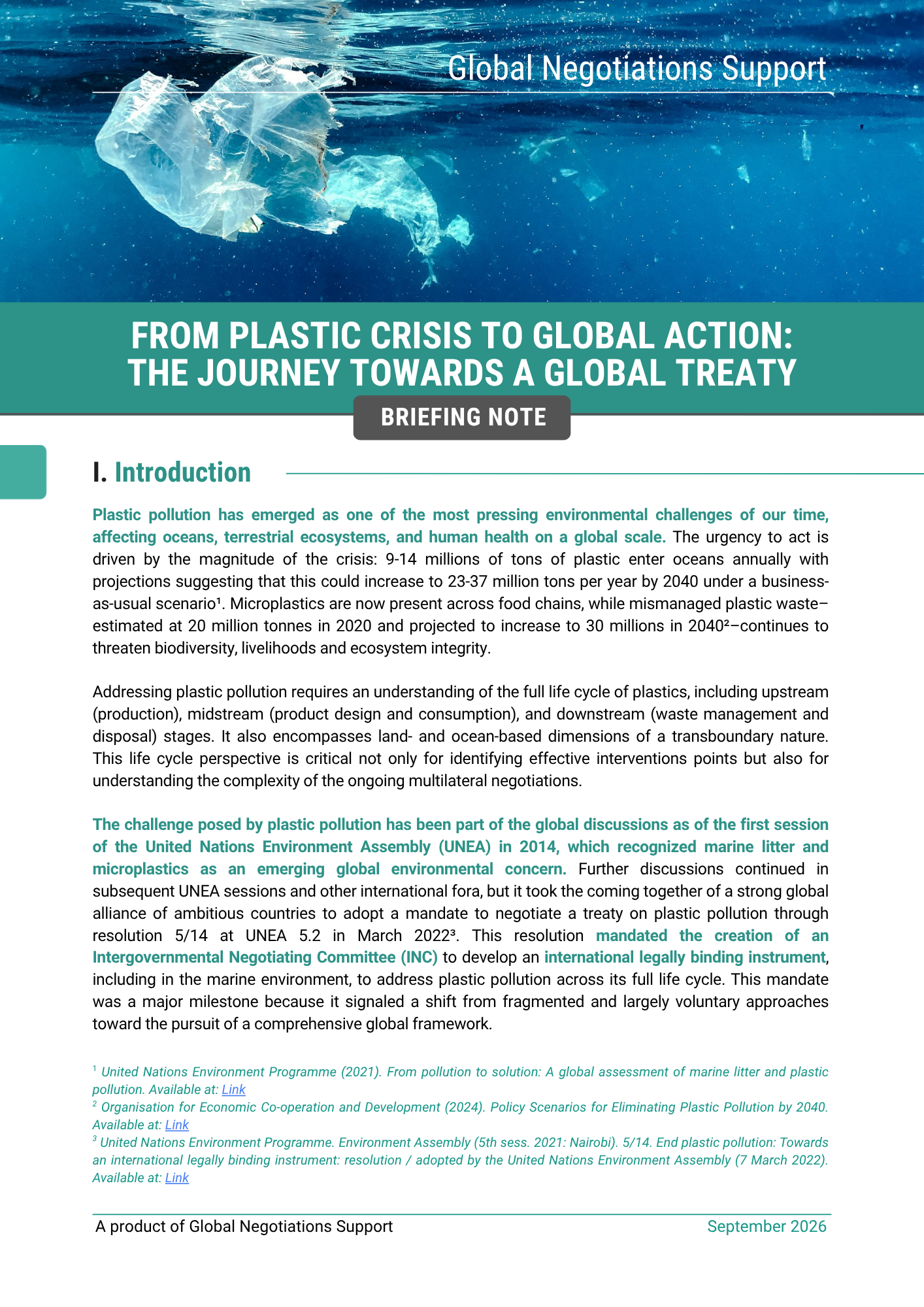
Plastic pollution has emerged as one of the most pressing environmental challenges of our time, affecting oceans, terrestrial ecosystems, and human health on a global scale. The urgency to act is driven by the magnitude of the crisis: 9-14 millions of tons of plastic enter oceans annually with projections suggesting that this could increase to 23-37 million tons per year by 2040 under a business-as-usual scenario. Microplastics are now present across food chains, while mismanaged plastic waste–estimated at 20 million tonnes in 2020 and projected to increase to 30 millions in 2040–continues to threaten biodiversity, livelihoods and ecosystem integrity.
Addressing plastic pollution requires an understanding of the full life cycle of plastics, including upstream (production), midstream (product design and consumption), and downstream (waste management and disposal) stages. It also encompasses land- and ocean-based dimensions of a transboundary nature. This life cycle perspective is critical not only for identifying effective interventions points but also for understanding the complexity of the ongoing multilateral negotiations.
The challenge posed by plastic pollution has been part of the global discussions as of the first session of the United Nations Environment Assembly (UNEA) in 2014, which recognized marine litter and microplastics as an emerging global environmental concern. Further discussions continued in subsequent UNEA sessions and other international fora, but it took the coming together of a strong global alliance of ambitious countries to adopt a mandate to negotiate a treaty on plastic pollution through resolution 5/14 at UNEA 5.2 in March 2022. This resolution mandated the creation of an Intergovernmental Negotiating Committee (INC) to develop an international legally binding instrument, including in the marine environment, to address plastic pollution across its full life cycle. This mandate was a major milestone because it signaled a shift from fragmented and largely voluntary approaches toward the pursuit of a comprehensive global framework.
This explainer aims to analyze the progress achieved so far, the key areas of contention that continue to shape the negotiations, and the prospects for reaching agreement ahead of INC-5.4, expected to take place in early 2027. Given the protracted nature of the negotiations, as well as the increasing fatigue among delegations and potential resource constraints, there appears to be limited expectation that the process will extend significantly beyond this session. The article also offers reflections on potential pathways forward to support the successful conclusion of an effective and ambitious global instrument.